Want to Fish in Germany? First You Have to... Study
A small story about learning, taking the exam, applying for a fishing licence, and buying permits before fishing in Germany.
- Author
- FlamaBloom
- Published
- July 19, 2026
- Updated
- July 19, 2026
- Reading time
- 5 min read
If someone asked me:
"What do you need to prepare if you want to start fishing in Germany?"
Many people would probably think of a fishing rod.
Or a box of bait.
Or a folding chair to sit by the lake all afternoon.
But no.
In Germany, the first thing you need to prepare for is... going to class.
Yes.
If you want to catch a fish, first you need a licence.
When I first heard this, I was quite surprised too.
In Vietnam, I had often seen people simply bring a fishing rod and sit by a riverbank or a lake. In Germany, fishing is treated as a responsibility. You do not only learn how to fish. You also learn how to respect nature and how to treat the living creatures you catch properly.
So before you are allowed to hold a fishing rod, you first have to sit in... a classroom.
The required course time is usually 30 to 36 hours of theory and practice.
The number of sessions depends on the type of course you choose: a weekend course, evening classes during the week, or a flexible online course. The course can last from a few days, if it is an intensive one, to several weeks.
The course fee ranges from 150 to 200 euros.
But just as I registered, Germany was in the middle of the Covid period.
So I signed up for an online course.
All the lessons had been recorded as videos.
I had to study every lesson and then take online tests.
Only after completing the course and passing an online test did I receive the certificate I needed to register for the fishing licence exam.
This time was different from the driving licence exam.
My German had improved a lot by then.
At least I no longer knew only how to say Hallo and Danke.
Even so...
About 600 practice questions were still enough to make me spend many evenings studying.
The more I learned, the more interesting it became.
Besides the legal rules, I also learned how to identify fish species, spawning seasons, the minimum size of fish you are allowed to keep, common fish diseases, and even how to kill a fish according to the rules so that it suffers as little as possible.
There was knowledge I had never even thought about before.
And from that, I understood that in Germany, fishing is not only a hobby.
It is also a responsibility.
I still remember the exam day very clearly.
The exam location was about thirty kilometers from home.
That day, my father-in-law drove me there.
He also has a fishing licence and has been a member of a fishing club for almost thirty years.
Maybe that was why he was even more excited than I was.
I was a little nervous.
My father-in-law, on the other hand, was very confident.
What he said was more or less:
"Just go in and take the exam."
Maybe he had become used to the fact that, when I started learning something new, I often did not know much at the beginning.
But once I went to the exam... I somehow passed.
Luckily, I did not disappoint him this time either.
I passed the exam on my first attempt.
Passing the exam was only the first step.
The exam fee, as I remember it, was under 50 euros.
After receiving the notice that I had passed, I still had to go to the administrative office to apply for the official fishing licence.
At that time, there were several options.
A one-year licence.
A ten-year licence.
Or a licence that is valid for life.
I calculated it back and forth for a while.
In the end, I chose the 10-year option because it seemed the most reasonable.
At this point, many people might think:
"So that is it, right?"
Not yet.
In Germany, having the licence alone still does not mean you can fish.
You also have to buy a fishing rod, a landing net, a tackle box...
A basic set costs around two hundred euros as well.
And the most interesting part is...
If you want to fish in a particular lake or river, you also have to buy the fishing permit for that specific place.
Usually, it costs around twenty euros for one day.
I registered as a regular member of a lake near home.
The fee is about 155 euros per year.
In return, whenever I have time, I can go to the lake.
Some people like buying watches.
Some people like collecting handbags.
Everyone has a hobby that makes them willing to spend a little extra.
For me...
I only need a quiet morning by the lake.
A fishing rod.
A hot cup of coffee.
Birdsong somewhere in the woods.
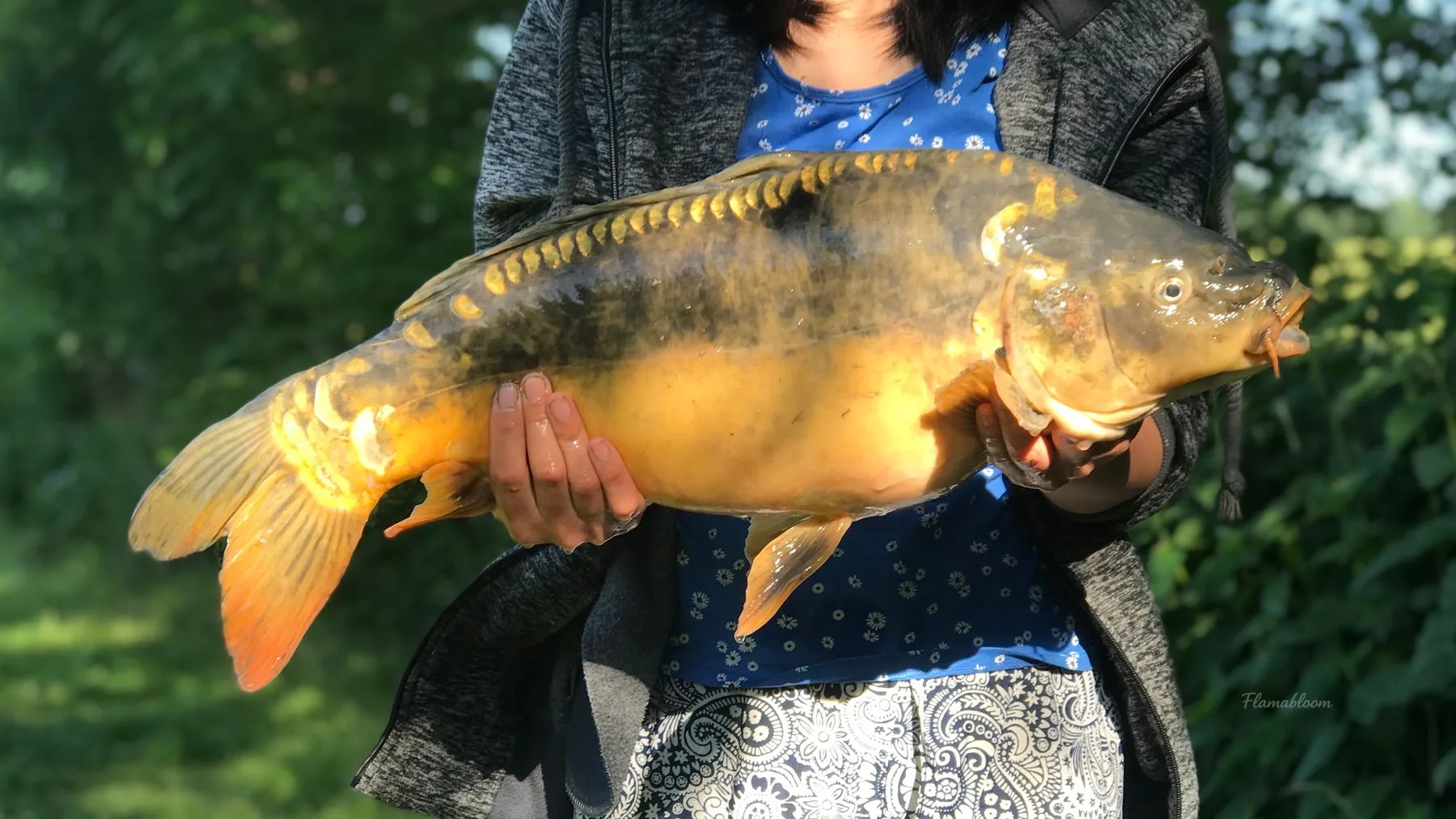
And if I am lucky enough that day to catch a really big fish...
then I will be happy all day, like a child who has just received a gift.
What I like most about fishing is not how many fish I can bring home.
It is the time I get to sit for a very long while without needing to do anything.
No phone.
No work.
No rushing.
Just sitting quietly and looking at the water.
Some days, the fish do not bite.
But I still feel the trip was worth it.
Maybe because sometimes, what I catch is not a fish.
It is a little bit of peace after busy days.