Ten Years to Travel Five Kilometres
A gentle story about finally visiting a German drive-in cinema five kilometres from home, with radio sound, rollerblading staff, and a little regret.
- Author
- FlamaBloom
- Published
- August 19, 2026
- Updated
- August 19, 2026
- Reading time
- 6 min read
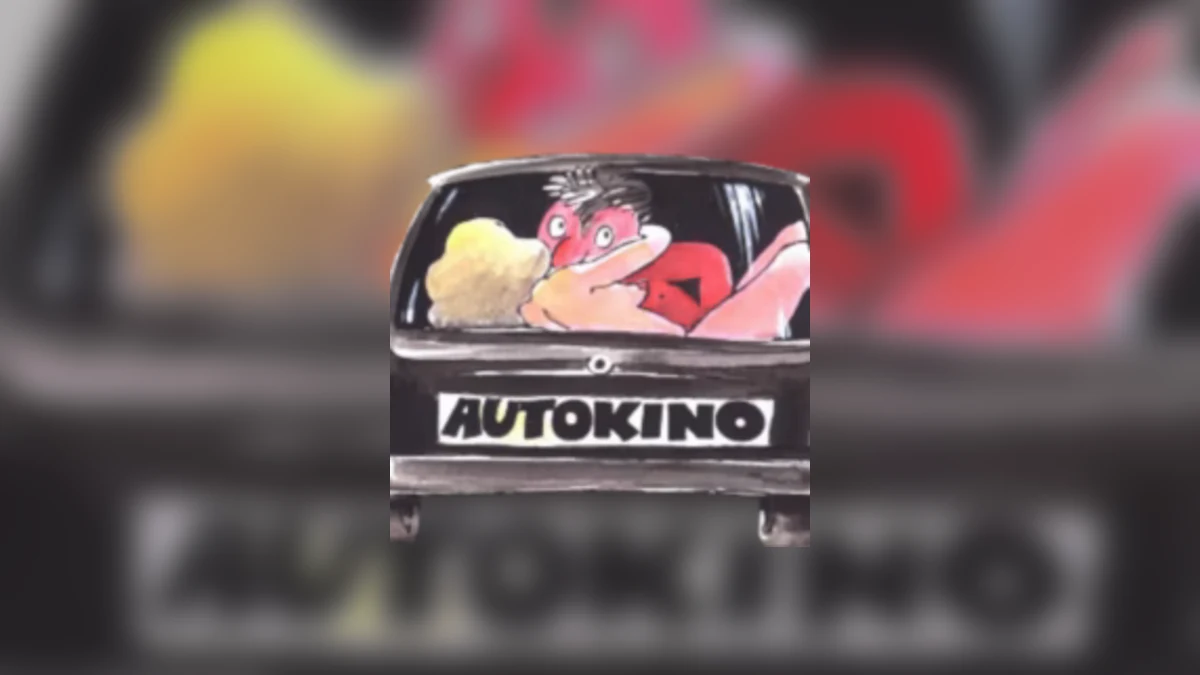
We live exactly five kilometres from a drive-in cinema.
It is so close that you would hardly even call the journey an outing. You get in the car, drive for a few minutes, and arrive before the song on the radio has had time to finish.
And yet it took me more than ten years to get there.
The drive-in sits beside a reservoir. In summer, the place is always humming with life: people linger over coffee, go swimming or pitch their tents for the night. Sunlight sparkles on the water, while signs advertising the Autokino seem to appear everywhere, patiently asking me:
“So, when are you finally coming to visit?”
To be honest, those signs did very little to help me understand what an Autokino actually was.
The poster showed two adults in a car, rather… busy with whatever they were doing. It was supposedly advertising a cinema, yet there was not a screen in sight. No projector. No popcorn. Not even a face watching a film with rapt attention.
So for a long time, the whole idea of an Autokino remained rather vague in my mind. Slightly suspicious, even.
Still, every time I drove past, I would think:
“I really must go there one day.”
But that “one day” kept being nudged further and further away.
People are funny like that. The farther away a place is, the more readily we add it to our plans. Somewhere we have never been always seems a little more exciting. Every weekend, our family looked for something to do with our child. Every holiday, we packed our bags, set off and travelled far from home.
All the while, a completely new experience sat just five kilometres away, waiting calmly for us for more than ten years.
Until one day, at last, we drove into the Autokino.
It was intriguing from the moment we reached the entrance.
Usually, when you drive into a car park, you are met by a ticket machine or an attendant at the gate. Here, the ticket they handed us was not for parking but for the film. Popcorn was being sold right beside the booth, as if the cinema and the car park had shaken hands and agreed to save their guests a few steps.
Compared with current cinema prices in Germany, the ticket was not terribly expensive—roughly 300,000 Vietnamese dong each.
There were no seat numbers.
No Row A or Row B to hunt down, and no particular chair waiting for us somewhere in the dark.
The earlier you arrived, the sooner you could choose your parking spot. At the front of the grounds stood the enormous screen, white and silent, waiting for nightfall. One by one, the cars found their places. They looked like a gathering of beetles that had come together to watch a film.
Several families who arrived after us even turned their cars around, opened the boot wide and arranged blankets and pillows so they could lie down while they watched. Some people had brought folding chairs. Some sat outside; others stayed in their cars.
Here, nobody had to sit neatly in the same position for two hours.
You could sit, lie down, stand up, swap places, tuck your legs underneath you or stretch them out. Just try not to drive away halfway through the film—that might be taking the freedom a little too far.
The Autokino near our home has three large screens, the equivalent of three separate auditoriums. Three different films can play at the same time on the same grounds.
That made me wonder: what happens to the sound? Would all three films talk over one another? Would the action hero shout into the romantic lead’s ear while an animated character tried to squeeze in with a song?
It turns out that the Autokino has a very clever solution.
Before the film begins, each car tunes its radio to the frequency assigned to its screen. The picture appears on the enormous screen ahead, while the sound comes through the car’s own speakers.
Three screens, three separate frequencies.
Outside, everything stays quiet. Inside each car, however, a different world unfolds. Turn the volume up or down, and you instantly have a private little cinema tailored to your own taste.
Before the film began, though, there was another kind of show.
If you wanted to order food, all you had to do was switch on your hazard lights.
A little later, a member of staff would glide over on rollerblades and take your order right at the car.
Perhaps the grounds are simply too large to cover on foot. Whatever the reason, I have to admit they looked very cool rolling up to the car window. For a few seconds, ordering a box of popcorn felt like stepping into an old American film.
The menu was far more varied than I had expected, too. There was not only popcorn, coffee and Coca-Cola, but burgers, pizza and plenty of other choices as well.
The sky slowly darkened.
One by one, the car lights went out. The giant screen came to life. Our radio found the right frequency.
And the film began.
I had always imagined that watching a film inside a car would feel cramped or inconvenient. The reality was the complete opposite.
Never had I felt so comfortable at the cinema. Our child could shift position without disturbing the person in the next seat. The adults could talk quietly. We could adjust the volume whenever we liked. And if we wanted to eat a burger during the film, we did not have to worry that the rustling wrapper would make an entire row in front of us turn around.
We were still watching a new film, on a large screen and in good quality, yet we had the private space of our own family car.
A cinema full of people, where every car was a tiny room of its own.
From the sources I have read, only around ten drive-in cinemas like this remain in Germany. Perhaps that is part of what makes the experience feel so special: modern and nostalgic at once; a trip to the cinema that also feels a little like an evening picnic.
When the film ended, there was no need for everyone to stand up at once, feel their way down dark steps or search for the car in a crowded car park.
We simply started the engine and drove home.
I left the radio tuned to the cinema’s frequency. Even after we had travelled almost 300 metres, the music from the end credits was still playing. It grew fainter as we drove, as though the film was not quite ready to say goodbye to us yet.
Sitting in the car, I suddenly felt a pang of regret.
I wished we had come sooner.
Over the past ten years, we had been to so many places. We had planned long journeys and searched for new experiences in faraway cities. Meanwhile, just five kilometres from home, a giant screen had been lighting up each night, staff had been gliding between rows of cars on rollerblades, and another world had been quietly broadcasting over the radio.
We spend so much time gazing into the distance.
And sometimes we forget how many fascinating things are right beside us, waiting patiently to be discovered.
What about you—would you like to experience a film at an Autokino in Germany?