Growing bitter melon in a greenhouse in Germany
How I grow bitter melon in a greenhouse in Germany: soaking the seeds, keeping seedlings warm, training the vines, pollinating flowers, and harvesting green fruit.
- Author
- FlamaBloom
- Published
- September 10, 2026
- Updated
- September 10, 2026
- Reading time
- 6 min read
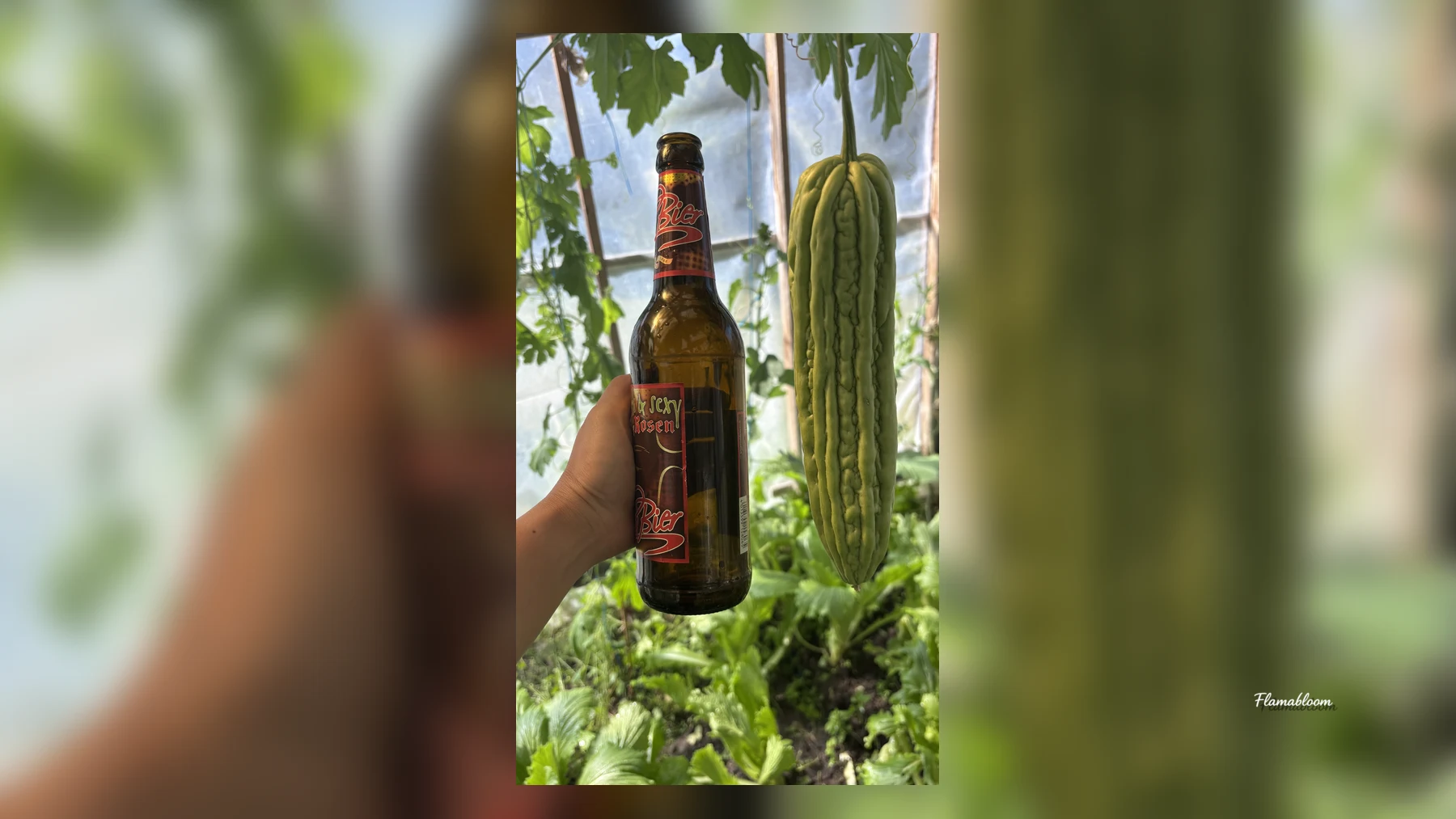
Summer in Germany is very short. The truly warm window for plants to grow sometimes feels just long enough for a vegetable season to begin before it is already hurrying toward the end.
For Asian vegetables that are used to heat and sun, growing them here is not always easy. Some seeds germinate very slowly. Some plants have barely grown before cold days return. Some years I care for the vines all season, and when harvest time comes, there are only a few fruits hanging here and there.
Even so, every year I try to keep a small corner of the greenhouse for vegetables that belong to meals from home.
Homesickness can be vague. Sometimes I do not know whether I miss a road, a season of sunlight, or an old kitchen. Food is much more concrete. You can place a familiar taste in your mouth, taste it slowly, and suddenly a whole field of memories returns.
That dish may not taste good to everyone.
But for me, just a little familiar flavor is enough to bring the whole summer back.
The vegetable I want to write about today is bitter melon.
A very honest name
In Germany, bitter melon is usually called Bittermelone or Bittergurke. In English, it is bitter melon. Its scientific name is Momordica charantia.
"Bitter" means bitter.
And that is not just a name. This fruit really is bitter.
The bitterness stays in every small piece. Stir-fry it, cook it in soup, or brew it as tea, and it still does not disappear completely. But that same bitterness is what gives bitter melon its character. Once you get used to eating it, you no longer taste only bitterness. You also notice a cooling, clean flavor that is hard to replace with another vegetable.
Bitter melon naturally likes a hot, humid climate. In Germany, if I want the plant to grow well and have enough time to set fruit, I usually grow it in a greenhouse or in a very sunny, warm, sheltered spot.
Starting with a stubborn seed
Bitter melon seeds are quite hard, so I do not sow them directly into soil right away.
First, I soak the seeds in water for at least eight hours, usually overnight. Then I place them in a damp cloth, put the cloth in a lidded container, and keep it somewhere dark and warm for a few days.
During this time, the cloth needs to stay moist but not soaking wet. I open the container once a day to check. When the seed coat begins to crack and a tiny white root appears, I gently place the seed into seed-starting soil.
I usually begin this in April. That way, by early May, when the weather is more stable, the seedlings are strong enough to move into the greenhouse.
If it is still cold outside or there is still a risk of frost, I wait a little longer. With bitter melon, moving a plant into the cold too early can undo weeks of careful tending.
A green trellis for summer
Bitter melon is a climbing plant, with a growth habit a little like cucumber. It needs string or a trellis to climb.
When the plant is still small, I tie a string from the base up to the upper frame of the greenhouse. As the stem grows longer, I gently guide the tip along the string. After that, the plant begins finding its own way, sending small tendrils around anything it can hold on to.
Bitter melon likes nutrient-rich soil, plenty of light, and fairly steady moisture. I water regularly but try not to let the soil stay waterlogged for too long.
On hot summer days, the plant grows very quickly. Within a short time, a few thin vines can turn into a green patch covering an entire corner of the greenhouse.
The flowers are small and yellow. If there are not many insects inside the greenhouse, I open the door often so bees and other pollinators can come in. When needed, I can also use a soft brush to move pollen from male flowers to female flowers.
With good care, one plant can produce quite a lot of fruit. I usually grow about five plants. That is enough for my family to eat bitter melon through summer, with some left to dry.
Harvesting while the fruit is still green
Bitter melon is best picked when the fruit has reached a good size but is still green and firm.
If it stays on the vine too long, it slowly turns yellow or orange, then splits open and reveals the red-covered seeds inside. Those fruits are beautiful to observe or keep for seed, but the flesh is no longer suitable for ordinary dishes in the same way as young green fruit.
Harvesting regularly also helps the plant keep flowering and setting new fruit.
Dishes that taste like home
Bitter melon can be prepared in many ways.
I often slice the fruit thinly and dry it for tea. The tea has a light, clean smell and leaves a little bitterness at the end.
Bitter melon is often mentioned as a food with interesting plant compounds, but I still see bitter melon tea as a drink from the garden, not medicine.
Fresh bitter melon can be sliced thinly and stir-fried with egg. The soft richness of the egg makes the bitterness gentler, which is nice for someone trying it for the first time.
Bitter melon can also be stuffed with meat, cooked with tomatoes, or made into a hot bowl of soup. Some people soak the slices in salt water before cooking to reduce the bitterness. I usually do not want to remove that flavor completely.
Because if it is no longer bitter, perhaps it is no longer the dish I am missing.
Growing a familiar flavor in a faraway garden
Bitter melon seeds are not too hard to find in Germany now. They can be bought at some Asian seed shops or online; eBay often has sellers too. Useful search terms include Bittermelone, Bittergurke, or the scientific name Momordica charantia.
Of course, growing bitter melon in Germany takes a little extra patience. The plant needs to be started early, kept warm, and protected on cold days. Not every year has friendly weather, and not every seed wants to germinate.
But then there will be a summer afternoon when I step into the greenhouse and see a small bitter melon swinging quietly under the leaves.
It is not only a vegetable I managed to grow.
It is an old flavor that has crossed many winters, traveled a very long way, and found a place to grow in a new garden.