Figleaf gourd – the squash that has never disappointed me
How I grow figleaf gourd in Germany: starting seeds at the right time, letting the vines climb, eating young fruits and storing mature ones through winter.
- Author
- FlamaBloom
- Published
- September 10, 2026
- Updated
- September 10, 2026
- Reading time
- 7 min read
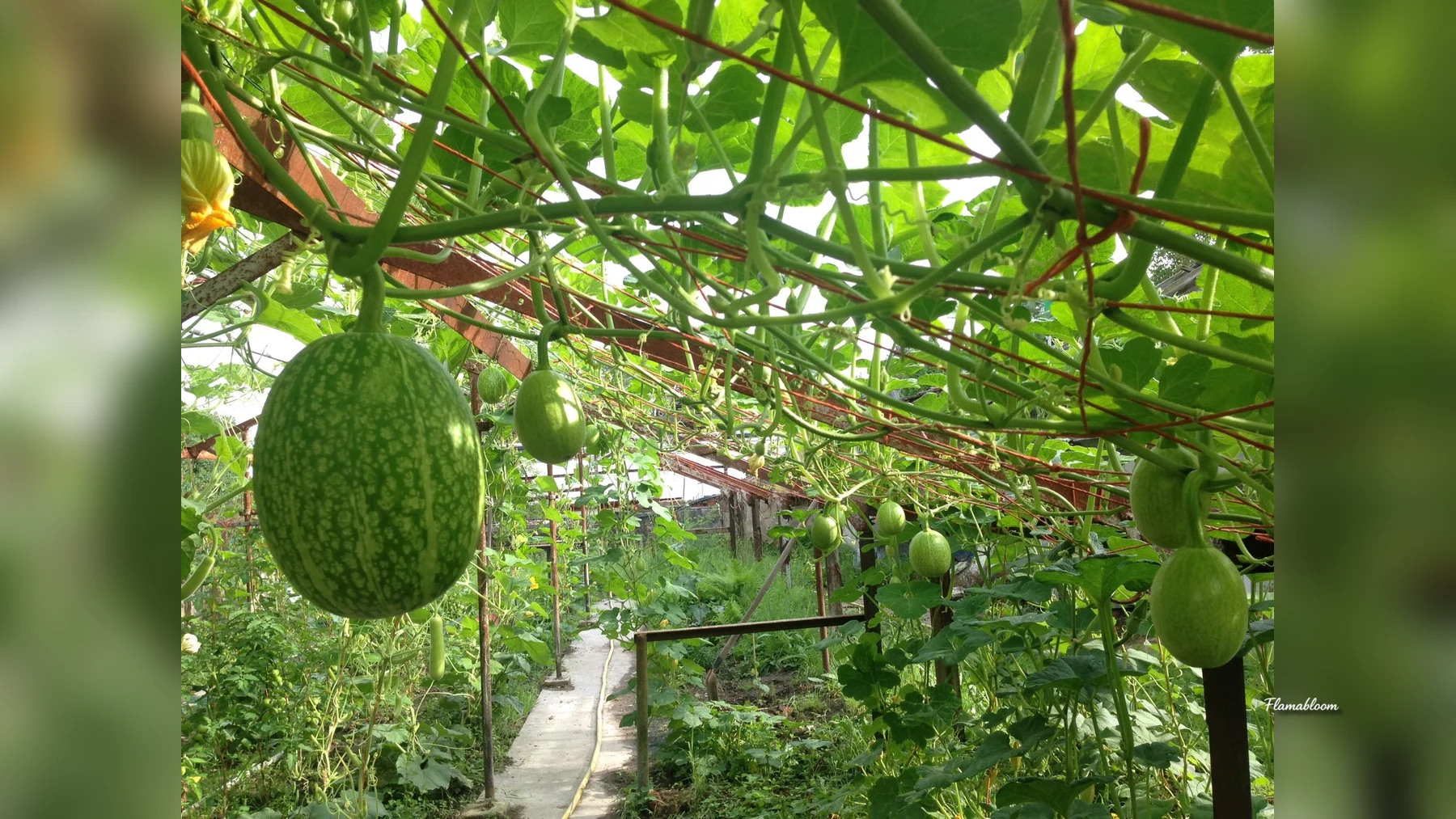
Summer in Germany is short. Some years, just as the garden finally turns green, the mornings already begin to feel cool again. The time when vegetables can really grow, flower and set fruit is not as long as it is in Vietnam.
That is why I often try one new plant each year. Some plants settle happily into the garden. Some give me only a few leaves and then stop. Some varieties keep me excited for the whole season, only to reach autumn without a single fruit.
Gardening in a place with a short summer feels a little like running small experiments. I put a seed into the soil and wait to see whether it can adapt to the light, the temperature and the rain here.
One of my most successful experiments has been the figleaf gourd.
A name from leaves and flesh
In Germany, this squash is called Feigenblattkürbis. Its botanical name is Cucurbita ficifolia.
The German name means fig-leaf squash. Once you have seen the plant, it makes sense immediately: the leaves are large, lobed and really do look a little like fig leaves.
The young fruits are green, sometimes marked with pale streaks or speckles, and at first glance they look a bit like small watermelons. But the most interesting part is inside. When the fruit matures, the white flesh no longer stays as one firm block. It slowly separates into long strands. Perhaps because those strands remind people of vegetarian shark fin soup, many Vietnamese speakers call it bí vi cá.
The first time I grew it, I had no idea how large the plant would become, how many fruits it would make or what it would taste like. I sowed it mostly out of curiosity. But the more I watched it, the more I felt it was one of the most interesting and generous squash plants in the garden.
Do not start it too early
Starting figleaf gourd is quite similar to starting other squash.
I soak the seeds in water for about eight hours, usually overnight. Then I place them in a damp cloth, put that into a lidded container and keep it somewhere dark and warm for about three days. When the seed coat cracks and the small white root begins to appear, I move the seed into potting soil.
Figleaf gourd has very strong roots, and the young plants grow surprisingly fast. So there is no need to sow it too early.
If I plan to move the plants into the garden after May 15, when the risk of frost in Germany has usually dropped, starting them in early May can still be enough. The plants can grow a lot in just a few weeks.
I used to think that the earlier I started, the stronger the plants would be. But that is not always true. If a young plant spends too long in a small pot, with too little soil, too little light and not enough room for its roots, it can become weaker than a plant sown later but at the right moment.
In gardening, earlier is not always better. Sometimes the most important thing is simply to begin at the right time.
A vine that does not know when to stop
Figleaf gourd can crawl along the ground like other squash. But if it has a trellis, frame or fence, it climbs very quickly.
I like letting it climb on the fence. The leaves and stems receive plenty of light, the fruits do not sit directly on the soil, and the garden slowly gains a beautiful green wall.
Before planting, though, it is worth giving it enough space. This is not a tiny, well-behaved squash that sits quietly in a corner. Once it has rooted well, its vines can travel far, grip the fence, wander into the next bed and keep looking for more room.
In my garden, it is always one of the earliest squash plants to set fruit. The fruits grow very fast. Sometimes I look away for only a few days, and a small fruit has already become heavy under the leaves.
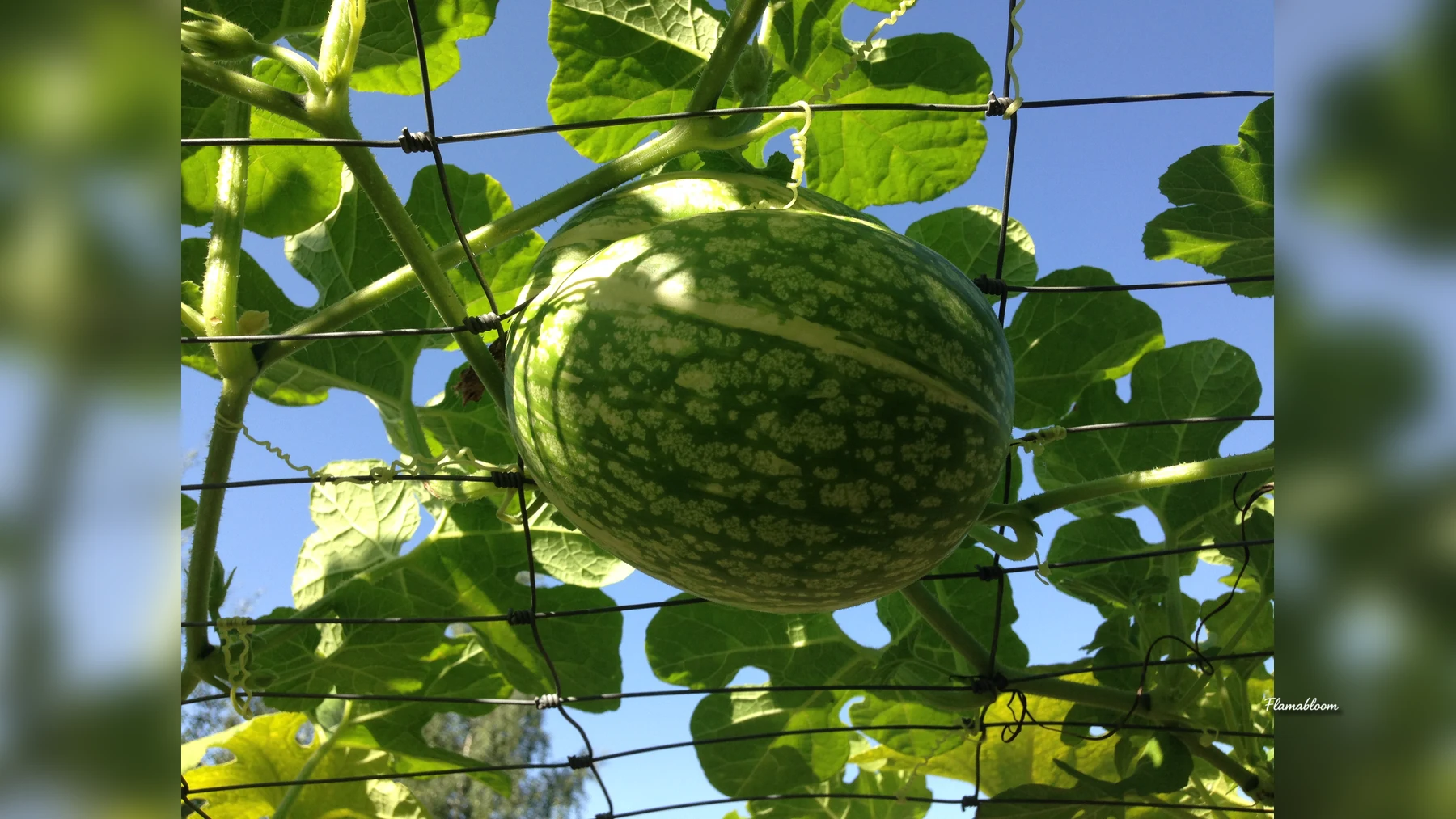
The plant also keeps setting fruit for quite a long time, often from June until the end of September, depending on the weather each year. With many other squash varieties, four or five fruits on one plant already feel like a good season. A healthy figleaf gourd can carry ten fruits and still continue flowering and sending out vines.
Young fruits as summer vegetables
When the fruit is still young and weighs a little over one kilogram, I can already harvest it for cooking.
At that stage, the skin is still soft and the seeds inside have not hardened, so there is almost nothing to discard. I just wash it, cut it open and cook it.
My favorite way is to cut the squash into fairly large pieces, coat them in batter or crumbs and fry them until crisp. The outside becomes lightly golden, while the inside stays soft and juicy.
Sometimes I add it to a simple Gemüsepfanne, a pan of mixed vegetables with whatever the garden happens to offer. Other times I slice it and stir-fry it with garlic. The white flesh is mild, a little like bottle gourd, and it does not overpower the other ingredients.
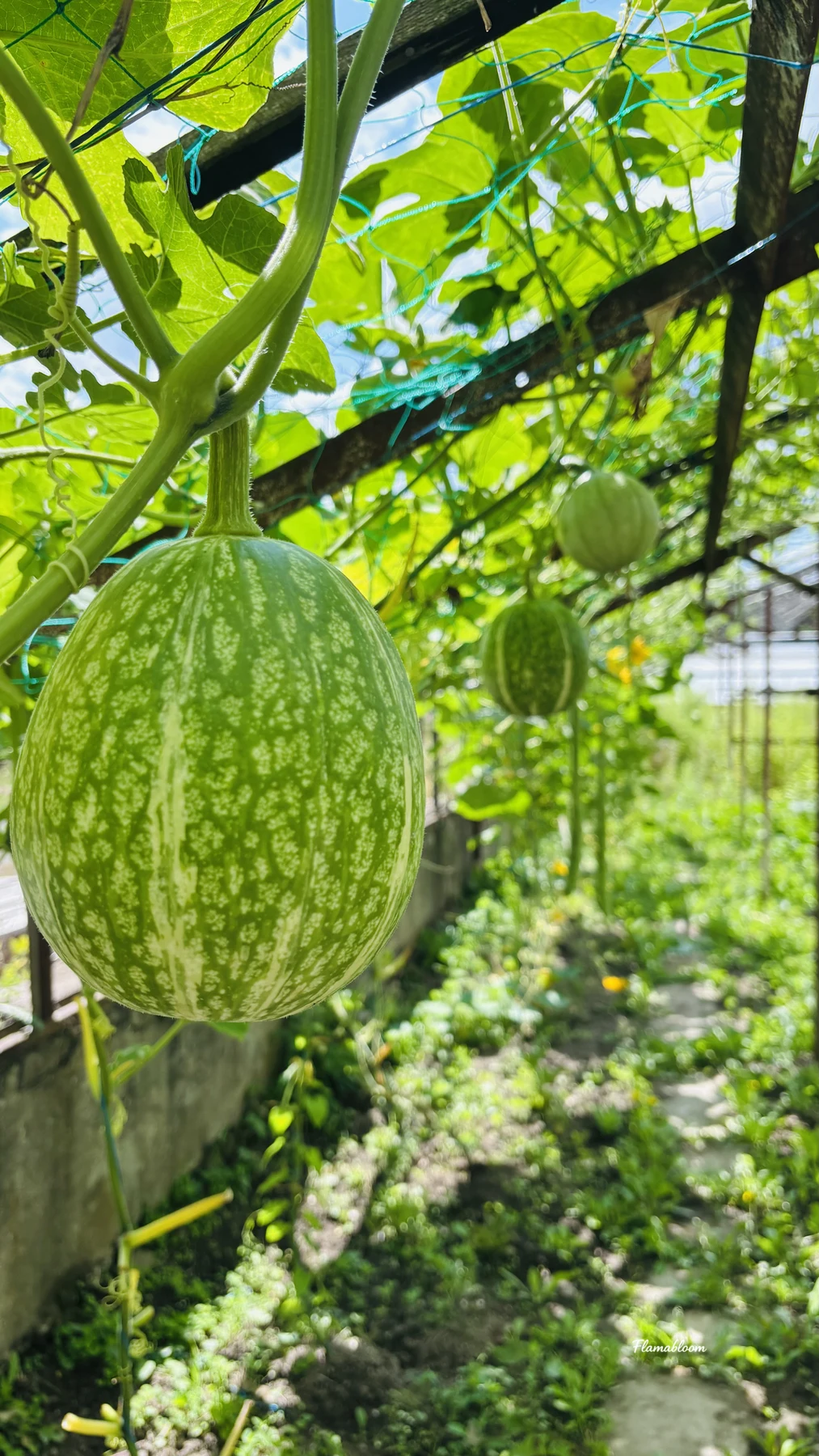
Because the flavor is gentle, most recipes that work with zucchini can also be tried with figleaf gourd: stir-frying, baking, coating and frying, cooking in soup or pickling. It is an easy fruit to bring into the kitchen, because it does not ask me to learn a completely new way of cooking.
When the fruit matures, the strands appear
If I do not harvest the fruit young but let it keep growing and ripen fully, figleaf gourd becomes a different ingredient altogether.
At that point, the skin is very hard. The flesh inside is still white, but the fibers begin to separate into long strands. The older the fruit, the clearer the strand structure becomes.
Those strands can be used in a vegetarian version of shark fin soup. They absorb broth, keep their texture and feel very different from pumpkin or ordinary zucchini.
In some places, the stringy flesh of figleaf gourd is also cooked with sugar into a sweet preserve called "angel hair" — Engelshaar in German, cabello de ángel in Spanish. The name alone is enough to make me want to save one ripe fruit at the end of the season and try it.
One squash can stay through several winters
One thing that surprised me most is how well figleaf gourd stores.
If the fruit is fully ripe, the skin is unbroken, the stem is intact and it is kept somewhere dry, cool and airy, it can last a very long time. I have had fruits sitting indoors for two or three winters without spoiling.
That makes figleaf gourd a special gift from the garden. Summer in Germany is short, but a squash harvested at the end of the season can keep a piece of the garden with me for many months afterward.
Roots strong enough to graft cucumbers
Figleaf gourd is not grown only for its fruit. Many people buy its seeds to use the plant as a rootstock for cucumbers.
The reason lies in its strong root system, vigorous growth and good resistance to some soil-borne diseases. After grafting, the roots of the figleaf gourd support the cucumber stem and fruit above.
I find that quite lovely: a plant can be generous enough not only to make many fruits of its own, but also to lend its roots to help another plant grow.
A squash for uncertain summers
After ten years of growing vegetables in Germany, I have collected plenty of failures.
Some years the eggplants did not have enough time to grow. Some plants flowered but never set fruit. Some seedlings were cared for indoors for weeks, only to fail after one cold night outside.
Those failures are part of gardening. Every season leaves behind a little experience, even if it sometimes leaves very few vegetables.
But figleaf gourd has never disappointed me.
It germinates strongly, grows fast, climbs far and gives more fruit than I expected. Young fruits can be eaten as summer vegetables. Mature fruits turn into those special strands for soup, sweets and winter storage.
If I could recommend only one squash to someone starting a garden in Germany, I would probably choose figleaf gourd.
Not because it is the most famous squash.
But because in a short summer that is not always kind, this plant still knows how to grow, climb over the fence and give the gardener more than they were waiting for.